
Which ERP is right for your business in 2026? A side-by-side breakdown of pricing, customization, manufacturing, implementation, and long-term scalability.
Introduction
Choosing the right Enterprise Resource Planning (ERP) system is one of the most important technology decisions a business will make. A well-implemented ERP platform improves operational efficiency, streamlines business processes, enhances collaboration, and provides real-time insights that support better decision-making.
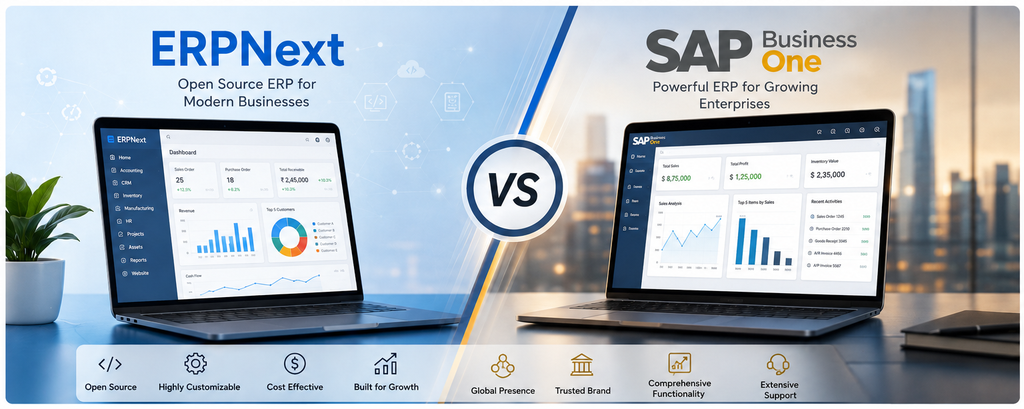
Two popular ERP solutions that businesses frequently compare are ERPNext and SAP Business One. Both systems are designed to help organizations manage finance, inventory, purchasing, sales, manufacturing, customer relationships, and other core operations. However, they differ significantly in licensing models, customization flexibility, implementation approach, total cost of ownership, and long-term scalability.
This guide compares ERPNext and SAP Business One across key business and technical areas to help you choose the solution that best fits your organization's needs.
What are they?
What is ERPNext?
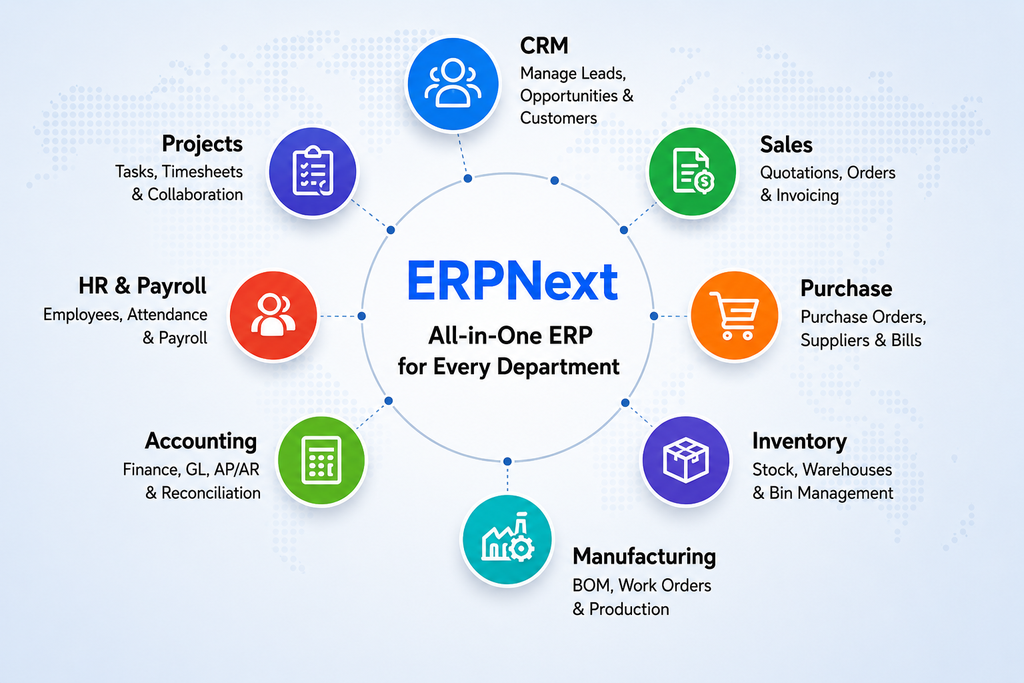
ERPNext is an open-source ERP platform built on the Frappe Framework. It provides an integrated solution for startups, small and medium-sized businesses, and growing enterprises, with modules for accounting, CRM, sales, purchasing, inventory, manufacturing, HR, payroll, projects, asset management, helpdesk, website management, and e-commerce. Because it is open source, businesses can customize ERPNext extensively without paying traditional software licensing fees.
What is SAP Business One?
SAP Business One is a commercial ERP solution developed by SAP specifically for small and medium-sized businesses. It provides comprehensive functionality across finance, purchasing, inventory, sales, customer management, production, and reporting. It's delivered through licensed partners and supports both on-premise and cloud deployments, backed by SAP's global ecosystem.
Quick comparison
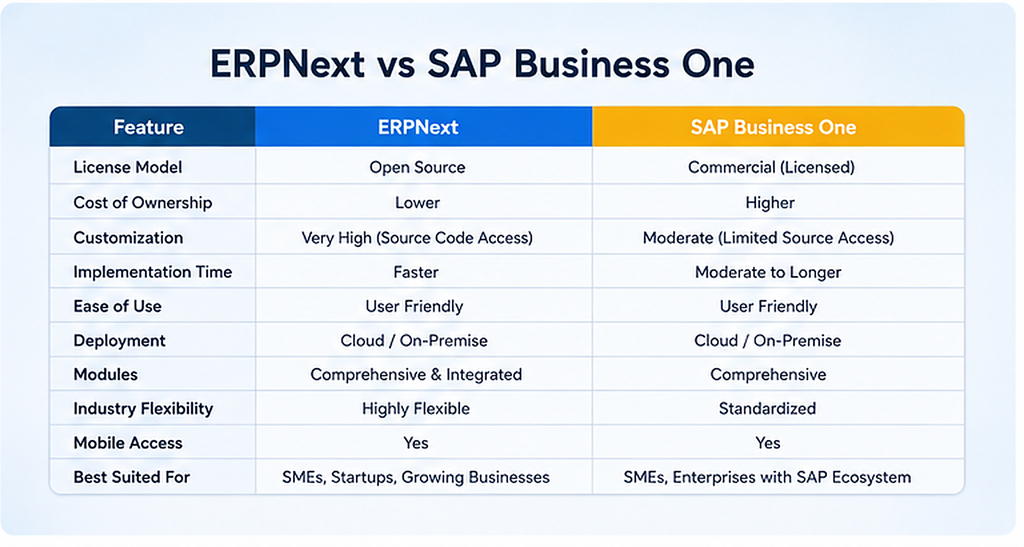
| Feature | ERPNext | SAP Business One |
|---|---|---|
| Licensing | Open Source | Commercial License |
| Deployment | Cloud & On-Premise | Cloud & On-Premise |
| Customization | Very High | Moderate to High |
| Source Code Access | Yes | No |
| Mobile Access | Yes | Yes |
| Manufacturing | Excellent | Excellent |
| Accounting | Comprehensive | Comprehensive |
| CRM | Built-in | Built-in |
| Website | Built-in | External |
| E-Commerce | Built-in | Integration Required |
| Workflow Automation | Excellent | Excellent |
| API Support | REST API | Service Layer & APIs |
Pricing
One of the biggest differences between the two systems is cost.
Where the money goes
Businesses primarily invest in implementation, customization, hosting, training, and support. There are no traditional per-user software license fees when self-hosted.
Where the money goes
Typical costs include software licenses, implementation, annual maintenance, infrastructure, support, and upgrades. For organizations with many users, licensing can become a significant portion of total cost.
Implementation
ERPNext implementations are generally faster because of the platform's flexibility and modular design. Organizations can implement core modules first and expand gradually.
SAP Business One implementations are usually more structured and may require additional planning depending on industry-specific requirements and partner methodology.
Ease of customization
ERPNext offers exceptional customization capabilities. Businesses can easily create:
- Custom Fields
- Custom Forms
- Approval Workflows
- Dashboards
- Reports
- Print Formats
- API Integrations
- Client Scripts
- Server Scripts
Because developers have access to the source code, organizations can build highly specialized business solutions.
SAP Business One also supports customization through development tools and partner solutions, but source code is not available, and changes typically depend on SAP-approved approaches.
Manufacturing
Both systems provide strong manufacturing capabilities.
ERPNext supports:
- Bill of Materials (BOM)
- Production Planning
- Work Orders
- Job Cards
- Capacity Planning
- Quality Inspection
- Subcontracting
- Multi-Level BOM
SAP Business One includes production management, resource planning, and inventory integration, making it suitable for many manufacturing businesses.
Financial management
Both ERP platforms offer comprehensive accounting functionality.
- General Ledger
- Accounts Payable
- Accounts Receivable
- Bank Reconciliation
- Budgeting
- Cost Centers
- Financial Statements
- Tax Management
- Multi-Currency Support
ERPNext's flexibility allows organizations to configure financial workflows according to local business requirements.
Reporting & dashboards
ERPNext provides real-time dashboards, report builders, and customizable analytics without requiring additional reporting tools for many common scenarios.
SAP Business One integrates well with SAP analytics products and supports advanced reporting, particularly for organizations already invested in the SAP ecosystem.
Scalability
ERPNext scales effectively from startups to large organizations through modular implementation and flexible infrastructure.
SAP Business One is also highly scalable and is often selected by growing businesses that anticipate deeper integration with other SAP products in the future.
Integration
ERPNext provides REST APIs, webhooks, background jobs, and extensive integration capabilities. Common integrations include:
- Shopify
- WooCommerce
- Payment Gateways
- Mobile Apps
- Business Intelligence Platforms
- Shipping Providers
SAP Business One also supports APIs and integration frameworks but may require additional partner expertise depending on project complexity.
Who should choose which?
Choose ERPNext if you are a…
- Startup
- Small business
- Manufacturing company
- Trading business
- Distribution company
- Service organization
- Educational institution
- Healthcare provider
- Construction company
Choose SAP Business One if you are…
- Already using SAP products
- Running standardized business processes
- Preferring licensed commercial software
- Planning long-term expansion within the SAP ecosystem
Advantages at a glance
- Open-source platform
- Lower total cost of ownership
- No traditional licensing fees for self-hosting
- Highly customizable
- Built-in website and e-commerce
- Modern user interface
- Active global community
- Strong API capabilities
- Backed by SAP
- Mature ERP platform
- Extensive partner network
- Strong financial management
- Comprehensive business functionality
- Suitable for businesses aligned with the SAP ecosystem
Final comparison
| Business Requirement | Recommended Solution |
|---|---|
| Lower Cost | ERPNext |
| Open Source | ERPNext |
| Maximum Customization | ERPNext |
| Built-in Website | ERPNext |
| E-Commerce | ERPNext |
| SAP Ecosystem Integration | SAP Business One |
| Established SAP Environment | SAP Business One |
| Rapid Custom Development | ERPNext |
| Flexible Deployment | Both |
Conclusion
Both ERPNext and SAP Business One are capable ERP solutions, but the right choice depends on your business goals, budget, technical requirements, and long-term strategy.
If your organization values flexibility, customization, open-source technology, and lower total cost of ownership, ERPNext is a compelling option. Its integrated modules, strong API capabilities, and active community make it suitable for businesses looking to adapt quickly and scale efficiently.
On the other hand, if your organization is already invested in the SAP ecosystem or prefers a commercial ERP platform with a broad partner network, SAP Business One may align better with your requirements.
The most successful ERP implementation is not simply about choosing software — it's about selecting a solution that supports your business processes today while enabling sustainable growth in the future.
We specialize in ERPNext, end to end.
Implementation, customization, cloud deployment, integrations, data migration, user training, and long-term support. We help businesses streamline operations and build scalable ERP solutions tailored to their industry and growth objectives.
Need help choosing the right ERP solution? Contact our team for a consultation to evaluate your business requirements and determine the best path forward.
Talk to our ERP team →

No comments yet. Login to start a new discussion Start a new discussion