
ERPNext vs Microsoft Dynamics 365: Which ERP Is Right for Your Business?
Which ERP is right for your business? A structured comparison across pricing, implementation, customization, manufacturing, CRM, reporting, and integrations.

Executive Summary
- ERPNext leads on cost, deployment speed, and customization freedom, largely due to open-source licensing and source-code access.
- Dynamics 365 leads on CRM sophistication and business intelligence, backed by native Power BI and Microsoft ecosystem integration.
- Both platforms are strong on manufacturing, accounting, and workflow automation — the difference is scale, not capability.
- Recommendation: ERPNext for startups, SMEs, and growing operational businesses; Dynamics 365 for large, Microsoft-standardized enterprises.
Two ERPs, two starting philosophies
Choosing an ERP shapes how finance, inventory, manufacturing, sales, customer service, and reporting work together for years to come. ERPNext is an open-source platform built on the Frappe Framework, valued for affordability, customization, and a full suite of integrated business apps. Microsoft Dynamics 365 is Microsoft's cloud business platform, pairing ERP and CRM with deep ties into Office 365, Teams, and Azure.
Platform A
ERPNext
Built for startups, SMEs, manufacturers, distributors, retailers, healthcare providers, and schools that want a customizable, cost-effective system.
- Accounting, CRM, Sales & Purchase
- Inventory & Manufacturing
- HR & Payroll, Helpdesk
- Built-in Website & E-Commerce
Platform B
Microsoft Dynamics 365
A cloud business application platform combining ERP and CRM, integrated tightly with Office 365, Teams, Outlook, Azure, and Power BI.
- Finance & Business Central
- Supply Chain Management
- Sales & Customer Service
- Field Service & Project Operations
Quick comparison
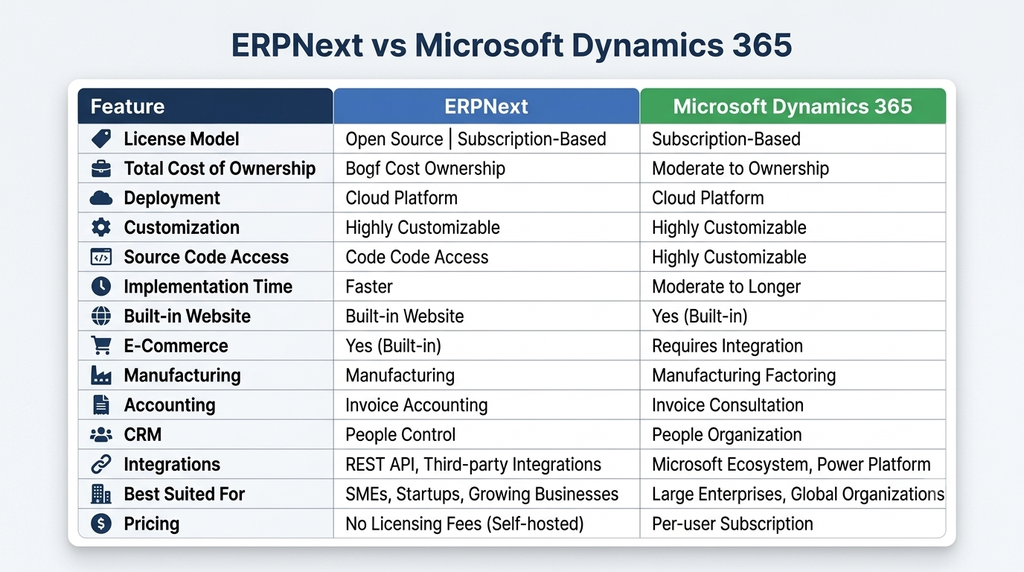
| Feature | ERPNext | Dynamics 365 |
|---|---|---|
| Licensing | Open Source | Subscription-based |
| Deployment | Cloud & On-premise | Primarily cloud |
| Customization | Excellent | Excellent |
| Source code access | Yes | No |
| Built-in website | Yes | No |
| E-commerce | Built-in | Requires integration |
| Manufacturing | Excellent | Excellent |
| Accounting | Comprehensive | Enterprise grade |
| CRM | Built-in | Advanced CRM |
| Mobile access | Yes | Yes |
| API support | REST API | Microsoft APIs |
| Workflow automation | Excellent | Excellent |
Where the two platforms actually differ
Pricing
ERPNext, self-hosted, carries no traditional licensing fees — spend goes toward implementation, hosting, and support. Dynamics 365 runs on per-user subscriptions plus implementation and integration costs, which can climb as the organization grows.
Lower cost of ownership — ERPNextEase of implementation
ERPNext's modular architecture lets teams start with core modules and expand later. Dynamics 365 often needs more upfront planning across departments.
Faster to stand up — ERPNextCustomization & flexibility
ERPNext offers full source-code freedom alongside custom fields, workflows, and REST APIs. Dynamics 365 supports strong customization through Microsoft's tooling and Power Platform, tied to licensed services.
Both strong — different freedom modelCRM & customer management
ERPNext bundles lead management, opportunity tracking, and support into the core system. Dynamics 365 brings one of the industry's most advanced CRM platforms.
Advanced CRM depth — Dynamics 365Reporting & business intelligence
ERPNext ships with customizable dashboards out of the box. Dynamics 365 goes further with deep Power BI integration for enterprise-scale analytics.
Enterprise BI depth — Dynamics 365The right ERP is not the one with the longest feature list — it is the one your organization can run on, from year one through year ten. — Nexeves Technologies, ERP Advisory
Manufacturing, finance, and scale
Both platforms hold up well on the fundamentals — it is the surrounding scale and ecosystem that pull them apart.
ERPNext
Manufacturing & supply chain
Covers Bill of Materials, production planning, work orders, job cards, MRP, quality inspection, and subcontracting — a complete shop-floor toolkit for growing manufacturers.
Dynamics 365
Manufacturing & supply chain
Offers advanced manufacturing and supply chain management built for larger enterprises running complex, multi-site operations.
Financial management
Both platforms cover general ledger, accounts payable and receivable, bank reconciliation, cost centers, budgeting, tax management, financial reporting, and multi-currency accounting. ERPNext delivers this without extra licensing complexity, keeping total cost predictable as the finance function grows.
Integration ecosystem
ERPNext
- Shopify & WooCommerce
- Payment gateways
- WhatsApp & mobile apps
- Shipping providers
- Third-party REST APIs
Dynamics 365
- Office 365 & Outlook
- Microsoft Teams
- Azure & SharePoint
- Power BI
- Power Automate
Who each platform actually suits
Choose ERPNext if you are a…
- Startup or small/medium business
- Manufacturer or trading company
- Retail or service business
- Educational institution or healthcare organization
- Team that wants flexibility, affordability, and fast customization
Choose Dynamics 365 if you are a…
- Large enterprise
- Organization already standardized on Microsoft
- Business with complex CRM requirements
- Company needing enterprise-scale analytics and automation
Final comparison
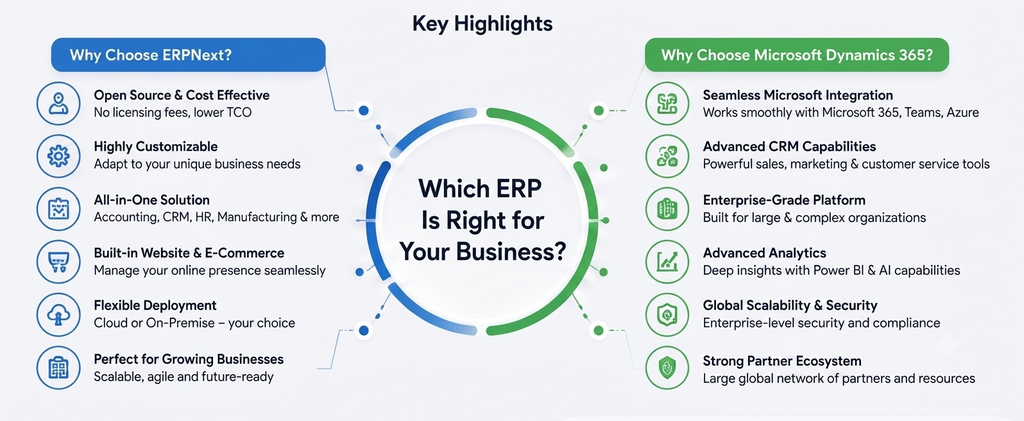
| Business requirement | Recommended platform |
|---|---|
| Lower cost | ERPNext |
| Open source | ERPNext |
| Maximum customization | ERPNext |
| Built-in website | ERPNext |
| Built-in e-commerce | ERPNext |
| Microsoft ecosystem | Dynamics 365 |
| Enterprise CRM | Dynamics 365 |
| Advanced business intelligence | Dynamics 365 |
| Small & medium businesses | ERPNext |
| Large enterprise environment | Dynamics 365 |
Conclusion
Both platforms are capable ERPs — the right choice depends on size, budget, technical requirements, and long-term strategy. If your organization values open-source technology, flexibility, and lower implementation costs, ERPNext delivers a complete suite of business applications without the weight of traditional licensing, making it especially attractive for startups, SMEs, and growing businesses. Microsoft Dynamics 365 is the stronger fit for enterprises that rely heavily on the Microsoft ecosystem and require advanced CRM, analytics, and enterprise-scale applications.
Build your business on ERPNext, done right
Nexeves Technologies implements, customizes, integrates, and optimizes ERPNext end to end — cloud deployment, data migration, API integrations, and user training included.


No comments yet. Login to start a new discussion Start a new discussion