
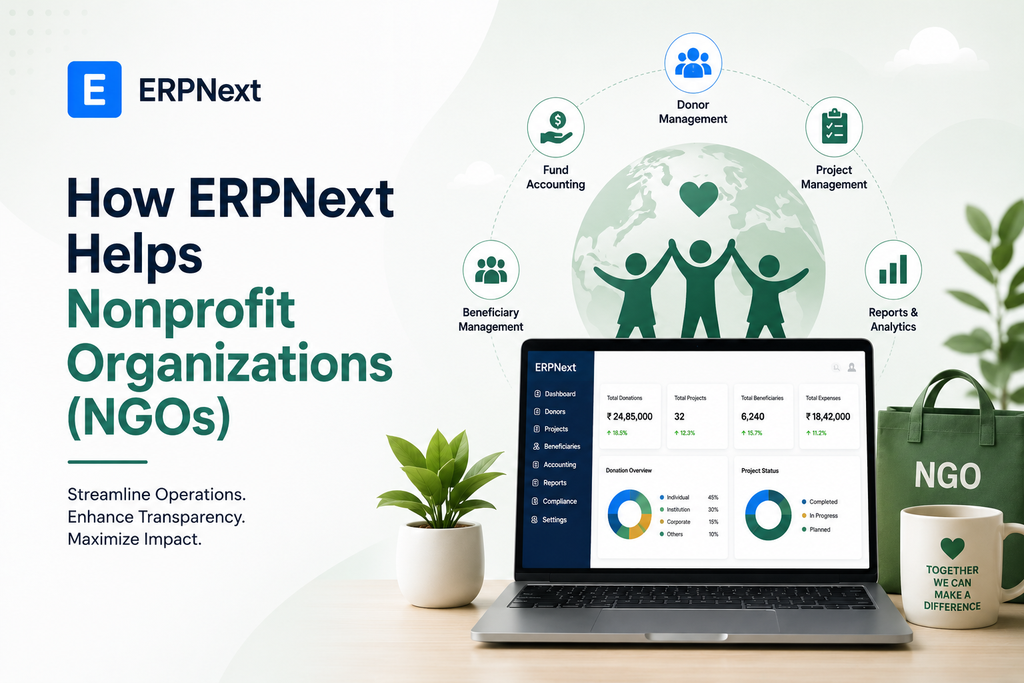
Nonprofit organizations operate in an environment where accountability, transparency, and efficiency are not just operational requirements but essential elements for survival. Unlike profit-driven companies, nonprofits must demonstrate to donors, government agencies, and stakeholders that every resource entrusted to them is used responsibly and effectively. As NGOs grow, managing donations, programs, volunteers, financial reporting, procurement, and organizational coordination becomes increasingly complex. Many organizations begin with spreadsheets and manual processes, but these tools quickly become insufficient as operational scale increases.
ERPNext provides nonprofit organizations with a unified system that allows them to manage all operational areas from one centralized platform. Instead of relying on disconnected tools, NGOs can manage donor relationships, financial records, projects, staff, and reporting within a single environment. This improves organizational efficiency, reduces administrative burden, strengthens donor trust, and enables leadership to focus on mission-driven activities rather than operational challenges.
This guide explains in depth how ERPNext supports nonprofit organizations from a business and operational perspective, helping them achieve sustainability, efficiency, and long-term impact.
1. The Growing Operational Complexity of Modern Nonprofits
Nonprofit organizations today operate in a far more complex environment than they did even a decade ago. Increasing competition for funding, stricter regulatory requirements, higher expectations for transparency, and expanding program scopes have significantly increased operational demands. NGOs must now manage multiple funding sources, coordinate large teams of staff and volunteers, oversee multiple projects simultaneously, and produce detailed reports for donors and regulatory bodies.
Many organizations initially rely on spreadsheets, email communication, and standalone accounting software. While these tools may work in early stages, they quickly become inefficient as the organization grows. Data becomes scattered across multiple systems, making it difficult to obtain accurate and timely information. Staff spend excessive time manually compiling reports, reconciling financial records, and searching for information.
This operational inefficiency not only wastes valuable time but also limits the organization’s ability to grow. Leadership may struggle to make informed decisions because reliable information is not readily available. Opportunities for expansion may be missed simply because administrative systems cannot support growth.
| Operational Stage | Typical Management Method | Challenges Faced |
|---|---|---|
| Small NGO | Spreadsheets and email | Limited scalability, manual tracking |
| Growing NGO | Multiple disconnected tools | Data duplication and inefficiency |
| Large NGO | Complex manual systems | Lack of visibility and coordination |
ERPNext helps NGOs transition from fragmented systems to a structured and scalable operational environment.
2. Centralizing Organizational Information in One Platform
One of the most transformative benefits ERPNext provides nonprofit organizations is centralization. Instead of storing donor data in spreadsheets, financial records in accounting software, and program information in documents, ERPNext allows all information to be stored in one unified system. This centralization eliminates confusion, reduces duplication, and ensures everyone works with accurate and consistent information.
When information is centralized, organizational visibility improves significantly. Leadership can instantly understand financial health, program performance, and donor engagement without waiting for manual reports. Staff can access the information they need quickly, improving productivity and reducing frustration.
Centralization also strengthens institutional memory. Nonprofits often experience staff turnover, and when information is stored in personal spreadsheets or emails, valuable knowledge may be lost. ERPNext ensures organizational knowledge remains accessible regardless of personnel changes.
This creates long-term operational stability and continuity.
3. Strengthening Financial Transparency and Donor Trust
Trust is one of the most valuable assets a nonprofit organization possesses. Donors contribute funds because they believe in the organization’s mission and expect their contributions to be used responsibly. Any lack of transparency can damage credibility and reduce future funding opportunities.
ERPNext helps NGOs maintain complete financial transparency by organizing all financial activities in a structured and traceable manner. Every donation, expense, and financial allocation is recorded clearly. Leadership can quickly see how funds are being used, and reports can be generated whenever needed.
This transparency strengthens relationships with donors. Organizations can confidently demonstrate how contributions are being used to create impact. This builds donor confidence and encourages continued support.
| Without ERPNext | With ERPNext |
|---|---|
| Manual financial tracking | Structured and organized financial records |
| Delayed reporting | Faster report generation |
| Limited financial visibility | Clear and accessible financial overview |
4. Improving Donor Relationship Management and Engagement
Donors are not just funding sources; they are long-term partners in the organization’s mission. Building and maintaining strong donor relationships is essential for sustainability. However, managing donor relationships manually can be challenging, especially as the number of donors grows.
ERPNext allows nonprofits to maintain detailed donor records, including donation history, communication records, and engagement activities. This enables organizations to understand donor behavior and preferences. They can identify loyal donors, recognize recurring contributors, and engage donors more effectively.
This improves communication and strengthens relationships. Donors feel valued when organizations maintain accurate records and communicate effectively. Strong donor relationships increase donor retention and improve long-term funding stability.
5. Supporting Responsible Grant and Fund Utilization
Many nonprofit organizations receive grants that must be used for specific purposes. Mismanagement or lack of clarity in fund utilization can create serious compliance and credibility issues. Managing multiple restricted funds manually can be extremely difficult.
ERPNext allows organizations to clearly track how each fund is used. Leadership can easily ensure that funds are allocated properly and used according to donor or grant requirements. This reduces the risk of misallocation and strengthens compliance.
| Fund Type | Purpose | Importance of Proper Tracking |
|---|---|---|
| Education fund | School programs | Ensures education activities are funded properly |
| Healthcare fund | Medical programs | Ensures healthcare support reaches beneficiaries |
| Emergency relief fund | Disaster response | Ensures rapid and accountable relief distribution |
6. Improving Organizational Efficiency and Reducing Administrative Work
Administrative work consumes a significant portion of nonprofit resources. Staff often spend excessive time managing spreadsheets, preparing reports, and coordinating information between departments. This reduces the time available for mission-driven activities.
ERPNext simplifies administrative processes by organizing information and reducing manual work. Staff can quickly access data, prepare reports, and coordinate activities. This improves productivity and allows staff to focus on programs and beneficiaries rather than paperwork.
Reducing administrative burden improves staff satisfaction and organizational efficiency.
7. Providing Leadership with Clear Organizational Visibility
Effective leadership requires accurate and timely information. Without clear visibility, leadership cannot make informed decisions. Many nonprofit leaders struggle to obtain reliable information because data is scattered across multiple systems.
ERPNext provides leadership with clear visibility into financial status, program performance, and organizational operations. Leaders can quickly identify challenges, monitor progress, and plan for the future.
This improves strategic planning and organizational growth.


No comments yet. Login to start a new discussion Start a new discussion